



Employment of Record Solutions in Australia: A Comparative Analysis of Top Leading EOR Service Providers
Finding the right Employer of Record provider when expanding overseas can feel like navigating a maze whilst blindfolded. You know there is a solution somewhere, but the path to get there often feels unnecessarily complex. Between unfamiliar labour laws, local tax obligations, mandatory benefits, and country-specific employment rules, hiring your first employee outside Australia introduces a long list of moving parts. That is precisely where EOR providers come in, taking on the legal employment responsibilities so you can stay focused on growing your business internationally.
Australian companies have increasingly turned to EOR services over the past few years, driven by global talent shortages, the rise of remote work, and the need to test new markets without committing to a full overseas entity. Whether you are a startup hiring your first team member in the UK or US, or an established Australian business expanding into multiple regions, understanding your EOR options is critical. This analysis examines seven prominent providers used by Australian companies for global hiring: Safeguard Global, Velocity Global, Skuad, TCWGlobal, Mercans, TopSource Worldwide, and Infotree Global.
What is an EOR?
An Employer of Record acts as the legal employer for your overseas workforce, handling payroll, local tax compliance, statutory benefits, employment contracts, and regulatory filings in each country. In practical terms, it allows your Australian business to employ staff globally without setting up a local entity in every market.
Your employees still work for you day to day. They report to your managers, follow your processes, and contribute directly to your company’s objectives. The EOR sits in the background, managing the legal and administrative requirements that vary from country to country.
For Australian companies expanding internationally, this structure reduces risk significantly. Employment laws in markets like the United States, Europe, and Asia can be highly specific and unforgiving. A single misstep, such as misclassifying an employee or failing to provide a mandatory benefit, can lead to fines, back pay, or legal disputes. An EOR absorbs that compliance burden, allowing you to operate confidently in unfamiliar jurisdictions.
Why Australian Companies Use EOR Services to Go Global
The decision to use an EOR typically comes down to speed, compliance, and cost control. Establishing a foreign legal entity can take months, require local directors or shareholders, and involve ongoing accounting and legal obligations. An EOR can often onboard your first international hire within days or weeks.
Compliance is one of the biggest drivers for Australian businesses expanding overseas. Each country has its own employment frameworks governing termination rights, notice periods, social contributions, leave entitlements, and payroll reporting. Managing these internally requires local expertise in every market you enter. EOR providers specialise in these regulations and update their processes as laws change, helping Australian companies avoid costly mistakes.
Cost effectiveness also plays a key role. For small teams or early-stage expansion, using an EOR is usually far more economical than setting up and maintaining foreign entities. Even at scale, many Australian businesses find the reduced administrative overhead and compliance risk justify the ongoing EOR fees. Importantly, it also protects against the financial impact of getting employment compliance wrong in unfamiliar markets.
The Global Employment Landscape for Australian Businesses
When hiring internationally, Australian companies quickly discover that employment standards vary widely across regions. Some countries mandate 13th-month salaries, others enforce strict worker protections that make terminations complex and expensive. Social security contributions, employer taxes, and statutory benefits differ not only by country but sometimes by region or job classification.
Unlike Australia’s centralised Fair Work system, many countries operate fragmented employment regimes where labour laws sit across national, state, and even municipal levels. This complexity makes assumptions particularly dangerous. What works in Australia rarely translates cleanly to overseas markets.
EOR providers bridge this gap by offering in-country expertise, standardised processes, and legally compliant employment structures. For Australian companies looking to expand globally without slowing down or exposing themselves to unnecessary risk, EORs have become a practical and increasingly strategic part of international growth.
Company Profiles
#1 Safeguard Global

Safeguard Global brings extensive global employment experience to Australian companies expanding overseas, with more than 18 years supporting international hiring. They work with over 1,500 organisations worldwide and enable compliant employment in 187 countries without the need for local entities. This scale is underpinned by a network of 400 plus in-country experts who provide deep local knowledge of labour laws, employment practices, and cultural expectations across key markets including the USA, UK, Canada, Singapore, Brazil, Poland, and India.
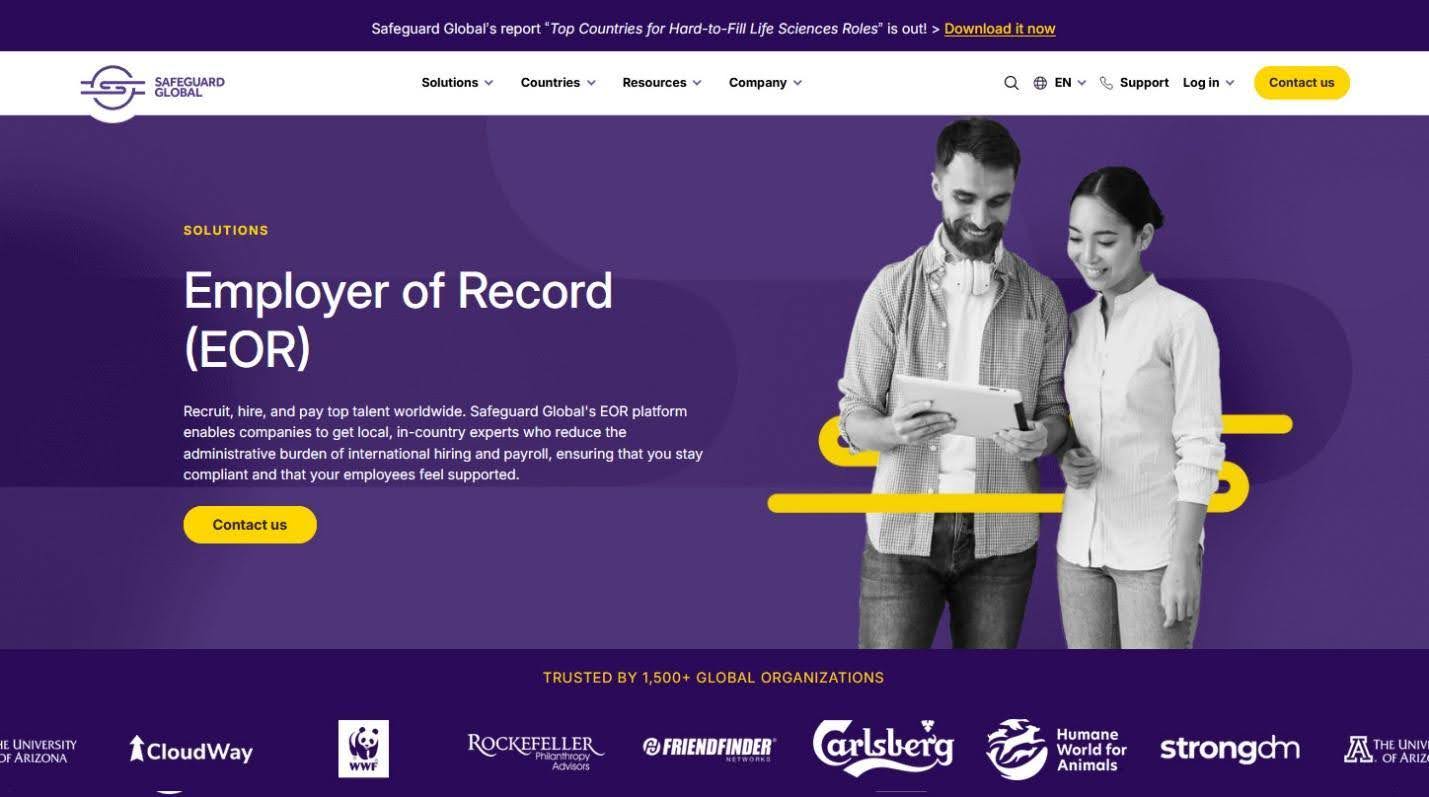
Rather than positioning themselves purely as a technology platform, Safeguard Global operates with a clear compliance-first approach. Their service model is designed for Australian businesses that want confidence when hiring internationally, particularly in jurisdictions with complex or rapidly evolving employment regulations. For companies entering markets like Brazil with its extensive labour protections, Poland with its specific contract requirements, or navigating employment-at-will frameworks in the USA, this emphasis on compliance and local expertise helps reduce risk while maintaining momentum during expansion.
Safeguard Global is typically viewed as a premium provider, and this is reflected in both pricing and service depth. Australian businesses are not simply purchasing payroll processing across multiple countries. They gain access to employment law specialists in each jurisdiction, proactive compliance oversight that accounts for regional differences, and structured guidance that helps prevent issues before they escalate into disputes or penalties. For businesses operating across the Americas, Europe, and Asia simultaneously, this level of support can be especially valuable where internal HR teams lack expertise in markets as diverse as São Paulo, Warsaw, and Mumbai.
Their platform is built to reduce administrative workload for HR and finance teams managing international staff across multiple time zones and regulatory environments. Payroll, compliance tracking, and workforce data from your teams in North America, Europe, and Asia are consolidated into a single system, allowing you to oversee global headcount without relying on separate providers in each country. Real-time visibility into workforce costs, tax obligations, and employment status across markets as different as Canada and Singapore supports better forecasting and more controlled international growth.
The system also provides ongoing visibility into regulatory obligations and compliance milestones across jurisdictions. Rather than reacting to changes in Brazilian labour law, Polish employment contracts, or Indian payroll regulations after the fact, businesses benefit from structured processes that align with local requirements in each market. This is particularly important for Australian companies scaling into multiple regions simultaneously, where differences in employment frameworks between the USA, UK, and Asian markets can quickly become difficult to manage internally.
Safeguard Global’s service-led model is supported by dedicated account management with regional expertise, ensuring Australian companies are not left navigating international employment complexity alone. This relationship-based approach becomes particularly valuable when dealing with non-standard employment scenarios such as executive contracts in the USA, workforce restructuring in Brazil, or region-specific employment challenges in India that require nuanced handling rather than standardised solutions.
#2 Pebl

Speed defines Pebl’s market positioning, with the company emphasising rapid deployment and streamlined onboarding processes. They have built their operations around the needs of fast-moving technology and finance companies that cannot afford lengthy implementation timelines. In practice, this means an Australian business can often have international employees on payroll within one to two weeks rather than the typical three to four.
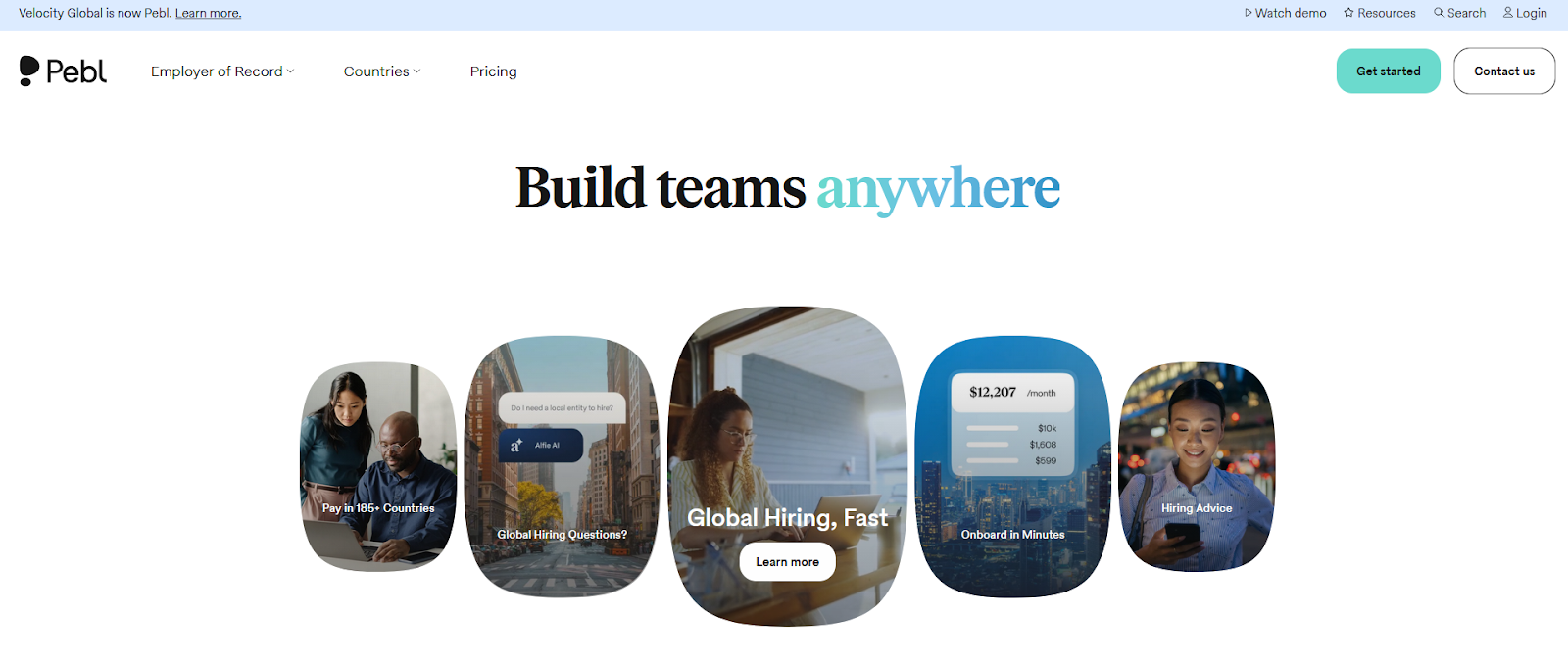
Their platform takes a modern approach to workforce management, with employee self-service portals and mobile accessibility. Pebl operates in over 185 countries, giving them broad reach for Australian firms planning multi-country expansions. Their global team maintains strong relationships with payroll providers and benefits administrators across various jurisdictions, which contributes to their quick turnaround times when entering new foreign markets.
#3 Skuad

As a relative newcomer founded in 2020, Skuad has disrupted the EOR market with competitive pricing and startup-friendly terms. Their monthly fees often come in 20–30% below traditional providers, making them attractive for Australian companies watching their burn rate closely while expanding into new territories. This cost advantage does not appear to come at the expense of compliance; the company has invested heavily in its technology platform and maintains local expertise in over 160 countries.

Skuad’s platform is purpose-built for the remote work era, with intuitive interfaces and minimal bureaucracy. They have focused particularly on the Asia-Pacific region, providing Australian businesses with strong regional infrastructure to support their growth. The company offers flexible contract terms, allowing you to scale your international teams up or down without being locked into lengthy commitments. Their support model is designed to ensure Australian companies can reach assistance during local business hours, regardless of where their global talent is located.
#4 TCWGlobal

TCWGlobal takes a compliance-first approach to EOR services, emphasising risk mitigation and regulatory adherence above all else. With operations in over 150 countries, they have built their reputation on helping Australian companies navigate complex foreign employment landscapes without stumbling into legal difficulties. Their global team includes legal experts and employment specialists who understand the nuances of local labour codes and classification requirements across multiple jurisdictions.

The company typically requires 12-month contracts, reflecting their focus on longer-term partnerships rather than short-term project-based engagements. This approach suits Australian firms committed to building a permanent international presence rather than testing the waters temporarily. Their setup timelines run slightly longer than some competitors, usually two to three weeks, as they conduct thorough compliance reviews and documentation processes upfront to ensure the Australian parent company remains protected.
#5 Mercans

Mercans positions itself as an enterprise-focused provider with particular strength in technology infrastructure. Their cloud-based platform, HR Blizz, handles not only standard EOR functions but also equity compensation, global mobility, and payroll consolidation across more than 160 countries. For Australian companies with complex compensation structures or employees moving between international locations, Mercans offers a level of sophistication that simpler providers struggle to match.
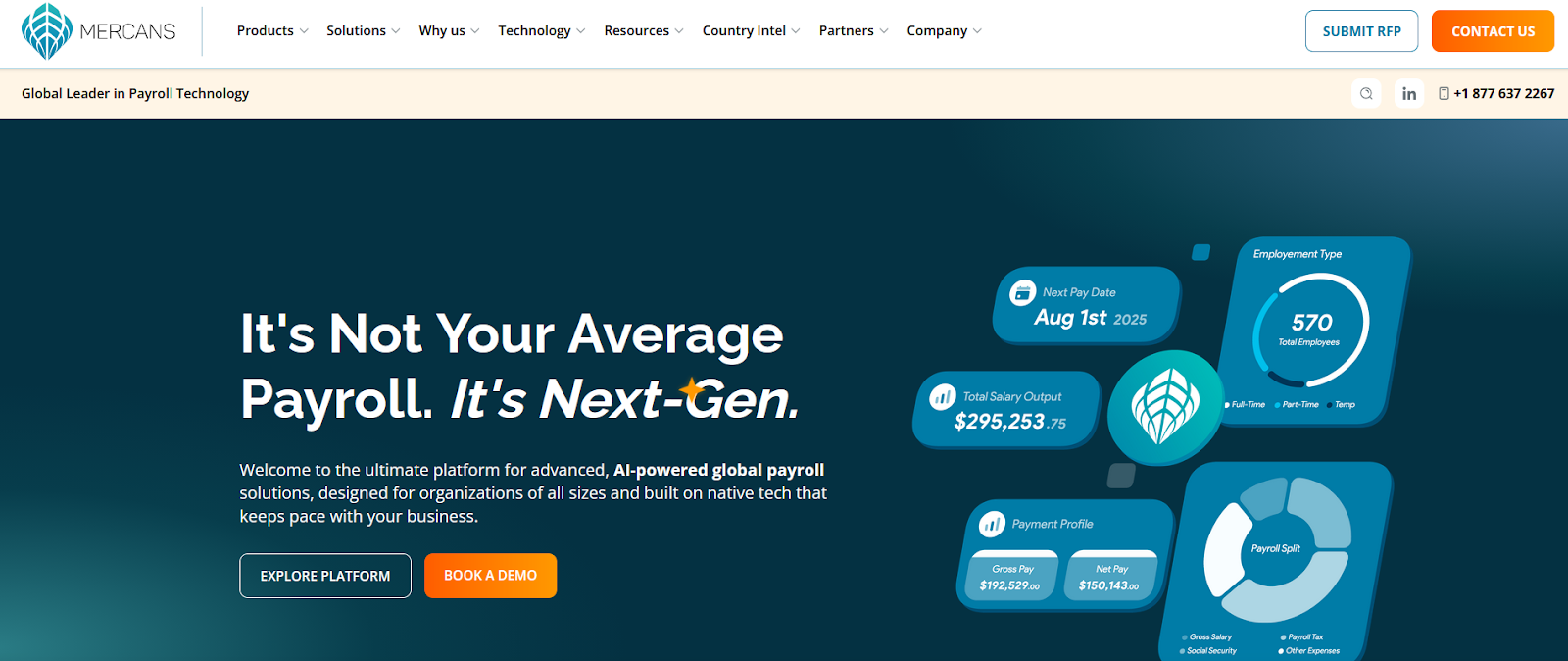
Operating across approximately 160 jurisdictions, Mercans combines broad geographic coverage with deep technical expertise. Their infrastructure allows Australian firms to manage a diverse global workforce through a single, unified system, which is particularly beneficial for those with multi-country expansion plans. The company’s pricing reflects its enterprise positioning, typically sitting at the higher end of the market. They offer 24/7 support and assign dedicated account managers to larger clients, providing a high-touch service experience for Australian businesses operating on a global scale.
#6 TopSource Worldwide

TopSource Worldwide has carved out a niche serving manufacturing, healthcare, and other sectors with specific compliance requirements. Their expertise in regulated industries is valuable for Australian companies where international employment classification and safety standards carry significant weight. While they originally focused on a smaller geographic footprint, they have expanded their reach to over 180 countries, providing deep support in the markets where they operate.

The company’s services are particularly suited to Australian businesses needing industry-specific guidance when hiring abroad. Their consultants understand how to manage sector-specific regulations and local labour codes that mirror the complexity of the Australian regulatory environment. While their traditional technology platform may lack the aesthetic polish of some newer competitors, it provides reliable functionality and a secure central hub for managing global teams. TopSource typically works with 12-month contracts and provides support during Australian business hours, which suits established firms with local management teams overseeing international growth.
#7 Infotree Global
Infotree Global brings a technical recruitment background to their EOR services, making them particularly strong for Australian technology and engineering firms hiring abroad. Their expertise in sourcing and managing technical talent extends into the employment relationship, with account managers who understand the specific needs of software developers and specialised engineers. They operate in over 150 countries with flexible contract terms that suit the project-based nature of the tech sector.
The company’s services assist Australian businesses by providing a bridge to competitive global talent markets. Their technology platform offers customisation options that some standardised systems lack, allowing you to tailor workflows and reporting to your specific international expansion goals. Support is structured to ensure that Australian management teams can coordinate with their global hires effectively, with coverage typically provided during Asia-Pacific business hours to maintain alignment across time zones.
Comparative Analysis
Service Offerings Comparison
| Company | Payroll Management | Benefits Administration | Visa Sponsorship | Compliance Support | Technology Platform | Customer Support |
| Safeguard Global | ✓ | ✓ | ✓ | ✓ | Proprietary | 24/7 |
| Velocity Global | ✓ | ✓ | ✓ | ✓ | Proprietary | Business hours |
| Skuad | ✓ | ✓ | ✓ | ✓ | Modern platform | 24/7 |
| TCWGlobal | ✓ | ✓ | ✓ | ✓ | Integrated | Business hours |
| Mercans | ✓ | ✓ | ✓ | ✓ | Cloud-based | 24/7 |
| TopSource Worldwide | ✓ | ✓ | Limited | ✓ | Traditional | Business hours |
| Infotree Global | ✓ | ✓ | ✓ | ✓ | Custom | Regional support |
All six providers cover the fundamental requirements of payroll processing, benefits administration, and compliance support. The differentiators emerge in areas like visa sponsorship capabilities, technology sophistication, and support availability. Companies with employees requiring work visas should note that TopSource Worldwide offers limited visa sponsorship services compared to other providers.
Support hours matter more than many companies initially realise. When payroll issues arise or urgent compliance questions need answering, having access to knowledgeable staff becomes critical. The 24/7 support offered by Safeguard Global, Skuad, and Mercans provides peace of mind for companies operating across multiple time zones or with managers outside Australia.
Pricing and Key Differentiators
| Company | Starting Price (approx.) | Contract Length | Setup Time | Global Coverage | Industry Specialisation | Key Differentiator |
| Safeguard Global | $500-800/month | 12 months | 1-2 weeks | 187+ countries | All industries | Established and Reliable presence |
| Velocity Global | $650-750/month | Flexible | 1-2 weeks | 185+ countries | Tech, Finance | Speed of deployment |
| Skuad | $400-500/month | Flexible | 1 week | 160+ countries | Startups, Tech | Competitive pricing |
| TCWGlobal | $500-700/month | 12 months | 2-4 weeks | 100+ countries | Professional services | Compliance focus |
| Mercans | $550-800/month | 12 months | 2-3 weeks | 150+ countries | Enterprise | Technology platform |
| TopSource Worldwide | $600-750/month | 12 months | 3-4 weeks | 75+ countries | Manufacturing, Healthcare | Industry expertise |
| Infotree Global | $450-650/month | Flexible | 2-3 weeks | 90+ countries | IT, Engineering | Technical recruitment |
Pricing varies significantly based on employee salaries, benefits packages, and any additional services required. The figures above represent typical starting points for standard employment arrangements. Companies should expect higher fees for senior executives or employees with complex compensation structures including equity, bonuses, or commissions.
Contract flexibility has become increasingly important in the current economic environment. Skuad, Velocity Global, and Infotree Global offer flexible terms that allow companies to adjust their commitments as circumstances change. Traditional providers like Safeguard Global, TCWGlobal, Mercans, and TopSource Worldwide typically require 12-month contracts, though they may offer exceptions for larger deployments or multi-country arrangements.
Setup timelines directly impact how quickly you can bring new hires onto your team. Velocity Global and Skuad have optimised their processes for speed, often completing onboarding within one to two weeks. This rapid deployment comes at the cost of more thorough upfront planning, whilst slower implementations by providers like TopSource Worldwide and TCWGlobal allow for more comprehensive compliance reviews and documentation processes.
Key Considerations for Australian Businesses Going Global
Choosing an EOR provider involves balancing multiple factors against your company’s specific needs and circumstances. Pricing certainly matters, but the cheapest option rarely proves the best choice when compliance issues or service problems emerge overseas. Companies should evaluate providers across several dimensions before making a decision.
Compliance capabilities should top your priority list. The EOR market has seen a proliferation of technology-focused platforms that excel at user interfaces but often fall short when complex employment situations arise. Many newer providers rely heavily on automated systems and third-party partnerships to handle compliance, which can create gaps in expertise and accountability. When a dispute arises in Jakarta or a regulatory change affects your employees in Berlin, you need access to experienced compliance professionals who understand local nuances, not just a helpdesk routing your enquiry through ticketing software.
Ask potential providers about their experience handling employment disputes in your target markets, how they stay current with local labour law changes, and what happens if a compliance issue arises. The best providers maintain dedicated compliance teams who monitor regulatory changes in each jurisdiction and proactively update their processes. They should also carry appropriate insurance to cover potential liabilities, though this shouldn’t replace your own due diligence in ensuring correct employment practices.
The technology versus service balance matters more than most companies anticipate. Whilst an attractive dashboard provides convenience for routine tasks, employment relationships involve nuanced human situations that software alone cannot resolve. Performance issues, visa complications, benefits questions, and employee grievances all require knowledgeable people who can provide context-specific guidance. Providers who’ve built their businesses around technology platforms often struggle with these situations, defaulting to generic responses or delayed escalations to human advisors.
Technology platform quality affects your daily experience with the EOR relationship. You’ll interact with the system regularly for payroll approvals, accessing reports, and managing employee information across different countries and time zones. Request demos from potential providers and have the people who’ll actually use the system evaluate its usability. Some platforms look impressive in sales presentations but prove clunky in practice, whilst others might lack visual polish but deliver reliable functionality.
Customer service responsiveness becomes critical when issues arise, particularly when you’re dealing with unfamiliar legal systems and working across significant time differences. Test potential providers’ responsiveness during the sales process, it usually reflects how they’ll treat you as a client. Ask about assigned account managers, escalation processes, and average response times for different types of enquiries. Australian companies expanding into Europe or North America should confirm support availability aligns with when their managers will need assistance, given the time zone gaps.
Consider the provider’s longevity and financial stability as well. The EOR industry has seen significant consolidation recently, with acquisitions and mergers changing company structures and service quality. Whilst newer entrants like Skuad bring competitive pricing and modern platforms, established providers offer stability and proven track records. Companies that have navigated multiple economic cycles, regulatory shifts, and geopolitical changes bring institutional knowledge that newer platforms simply cannot match. This experience becomes particularly valuable when unexpected situations arise, whether that’s navigating pandemic-related employment restrictions, managing employees during political instability, or adapting to sudden regulatory changes.
Our Top Recommendation for EOR: Safeguard Global
After evaluating the market comprehensively, Safeguard Global emerges as the strongest choice for most businesses expanding internationally. Their combination of established market presence, proven compliance capabilities, and human-centred service delivery addresses the most common pain points companies encounter with international employment.
Safeguard Global’s 187+ country coverage provides the broadest global reach amongst all providers, which matters when your expansion plans evolve beyond initial target markets. Their decades of experience show in how they handle complex situations. Where software-dependent providers might require you to submit tickets and wait for escalations, Safeguard Global’s established operations in each market mean you’re working with people who have direct experience managing employment in those jurisdictions.
The compliance expertise proves particularly valuable. Employment law varies dramatically between countries, and seemingly minor missteps can create significant liabilities. Safeguard Global maintains dedicated legal and compliance teams who actively monitor regulatory changes and update processes accordingly. When Australia’s Fair Work Commission introduced new casual employment classifications, for example, established providers had frameworks to assess similar changes in other jurisdictions. Newer, technology-focused competitors often struggle with these nuanced regulatory interpretations because they lack the institutional experience.
Their 24/7 support model recognises that employment issues don’t respect business hours. When your Singapore-based employee has a benefits question at 10pm Sydney time, or your London manager needs guidance on a performance issue at 7am Melbourne time, having access to knowledgeable staff prevents small concerns from escalating into larger problems. This accessibility, combined with assigned account managers who understand your business, creates continuity that automated systems cannot replicate.
The pricing sits at the higher end ($500-800/month), which reflects the depth of service provided. Companies sometimes baulk at the premium over budget-focused alternatives like Skuad, but the additional cost covers access to experienced compliance professionals, dedicated account management, and the institutional stability that comes with an established market presence. When you’re managing someone’s employment in an unfamiliar jurisdiction, the risk mitigation from working with an experienced provider far exceeds the monthly fee difference.
Alternative Considerations
Whilst Safeguard Global represents the strongest overall choice, specific circumstances might warrant considering alternatives.
For companies prioritising speed and budget efficiency, particularly in the technology sector, Skuad and Velocity Global merit consideration. Established companies with enterprise-scale requirements might also evaluate Mercans alongside Safeguard Global. Industry specialisation shouldn’t be overlooked in certain cases. The ability to work with consultants who understand your industry’s specific challenges and terminology streamlines communication and reduces friction, particularly when navigating unfamiliar regulatory environments.
Making Your Decision
The right EOR provider depends on your specific circumstances, but most Australian businesses will find Safeguard Global’s combination of coverage, experience, and service quality provides the foundation for successful international expansion. A Sydney startup hiring its first two employees in Singapore has different needs than an established Melbourne manufacturer setting up operations across Southeast Asia for 50 workers, but both benefit from working with a provider that prioritises human expertise over software automation.
Consider your immediate requirements, but also think about where your international operations might be in two years. Switching providers mid-stream creates unnecessary disruption and potential compliance gaps. Starting with a provider like Safeguard Global, who can support your growth from initial market testing through to established multi-country operations, provides continuity and reduces the complexity of managing international teams.
Request proposals from Safeguard Global and one or two alternatives that align with your preliminary assessment. Most companies should engage at least three providers in detailed discussions before committing. This allows you to compare not just pricing and contract terms, but also the quality of interaction with account teams, the depth of answers to compliance questions, and the overall confidence you feel in their ability to support your international ambitions.
The decision to expand internationally represents a significant commitment for any Australian business. Choosing the right EOR partner ensures that administrative and compliance complexities don’t distract from the strategic goals driving your expansion. Safeguard Global’s proven track record and comprehensive service approach provide the reliability and expertise most companies need to navigate international employment successfully.